You Don’t Have to Be a Comedian: 3 Ways to Add Laughs to a Serious Speech
Jel Salamanca | December 18, 2025
The “Humorous Speech” manual (or project) is the most dreaded assignment in public speaking.
You stare at the screen. You type a joke. You delete it because it sounds like a “Dad Joke” from 1998. You start sweating just thinking about the silence after the punchline.
Here is the good news: You do not need to tell jokes.
In fact, trying to “tell a joke” is usually why speakers fail. Unless you are a stand-up comic, structured jokes often feel forced, awkward, and disconnected from your message.
Instead of trying to be funny, you just need to add laughs to a speech by releasing tension.
Laughter isn’t always about comedy. It is about connection, surprise, and relief. Even in a serious business presentation or a somber speech, a well-placed laugh keeps the audience’s brain engaged.
Here are three “glitch-free” ways to get a laugh without wearing a clown nose.
1. The “Self-Deprecation” Patch
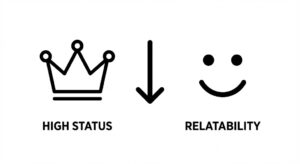
The quickest way to get an audience on your side is to lower your status.
When you stand on stage, you are automatically in a “high status” position. The audience is looking up to you. This creates a subconscious barrier.
Self-deprecation is a patch that lowers that barrier instantly. It says, “I am human. I make mistakes, just like you.”
How to do it: Don’t insult yourself or make it sad. Just highlight a minor “system failure” in your life that relates to your topic.
The Serious Topic: Time Management.
The Bad Joke: “Why did the chicken cross the road? To save time!” (Please don’t do this).
The Self-Deprecation: “I am here to talk about advanced time management strategies… which is ironic, considering I arrived here 4 minutes late because I couldn’t find my left shoe.”
The audience laughs because they have been there. You aren’t trying to be a comedian; you are just being honest about your own glitches.
2. The “Rule of Three” Twist
The human brain is a pattern-recognition machine. It loves predicting what comes next.
Comedy happens when you break that pattern.
The Rule of Three is the classic algorithm for this. You give the audience two items that establish a serious pattern, and then a third item that shatters it.
The Formula:
Normal Item (Sets the pattern)
Normal Item (Confirms the pattern)
Absurd Item (Breaks the pattern = Laughter)
How to do it: Let’s say you are giving a serious speech about health and fitness.
Serious Version: “To lose weight, you need to eat vegetables, exercise daily, and sleep well.” (Boring).
Rule of Three Version: “To lose weight, you need determination, discipline… and the ability to walk past a donut shop without crying.”
The laugh comes from the surprise. You can use this in almost any sentence. List two serious things, and then finish with something wildly specific or lazy.
3. The “Call Back” Link
This is a favorite hack of professional speakers because it makes you look incredibly sharp and present.
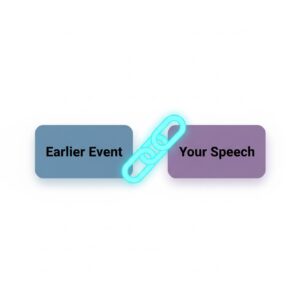
A “Call Back” is when you reference something that happened earlier in the meeting. It creates an inside joke between you and the audience. It proves you aren’t just reciting a memorized script—you are actually in the room with them.
How to do it: Pay attention before your speech.
Did the Sergeant-at-Arms struggle with the Zoom audio?
Did the previous speaker mention they love cats?
Did the air conditioning make a weird noise?
Weave that into your intro.
Example: “I was going to talk about how difficult it is to communicate with teenagers… but after watching us try to unmute Dave for 5 minutes, I think technology is the real enemy.”
You didn’t write a joke. You just pointed at reality. And because it just happened, it lands 10x harder than a prepared script.
💡 Pro Tip: Pause for the Download
The number one mistake speakers make when they actually get a laugh? They keep talking.
If the audience laughs, you must PAUSE. If you speak over their laughter, you are telling them “Stop having fun, I have data to deliver.”
Practice your pause discipline. Use a timer to get comfortable with silence.
When people laugh, they relax. When they relax, they learn.
If you are giving a dense, technical, or serious speech, you need these moments. They act as a “Save Point” for the audience’s brain. It gives them a second to breathe before you dive back into the heavy content.
You don’t need to be the class clown. You don’t need to look up “jokes for speeches” on Google.
Just be human (Self-Deprecation), break the pattern (Rule of Three), and be present (Call Back).
Ready to Time Your Laughs?
Comedy relies on timing. If you rush, you crush the moment. If you drag, you lose the energy.
Mastering the clock is the first step to mastering the stage.
Open it up, set a custom time, and practice your “Rule of Three” delivery until the timing feels natural.
Disclaimer: This guide is a personal resource created by Jel Salamanca. It is not an official publication of, nor is it affiliated with or endorsed by, Toastmasters International.