
You walk to the lectern. You feel confident. Your opening line is memorized.
Then, you reach for your notes.
Suddenly, the piece of paper in your hand turns into a seismograph. It is vibrating like a hummingbird’s wing. The more you try to stop it, the worse it gets.
If you have ever wondered, “Why do my hands shake only when I’m speaking?”—you are not broken. You are just experiencing a hardware overload.
The “Public Speaking Tremor” is one of the most common physical symptoms of stage fright. It can be embarrassing, but once you understand the biology behind it, you can hack your body to hide it.
The Science: It’s Not Fear, It’s Fuel
First, let’s debug the system. Why does this happen?
When you stand in front of a crowd, your brain’s amygdala (the threat detection center) misinterprets the situation. It sees 20 pairs of eyes staring at you and tags it as a “predator threat.”
Your body instantly triggers the Fight or Flight response.
Your system dumps a massive amount of adrenaline (epinephrine) into your bloodstream. This chemical is designed to make you fast and strong. It sends blood rushing to your large muscle groups so you can run away from a bear or fight a wolf.
Here is the glitch: You aren’t fighting a bear. You are giving a generic Toastmasters speech about your cat.
You have all this high-octane rocket fuel surging through your system, but you are standing perfectly still. That energy has nowhere to go. The result? It vibrates out through your extremities. Your hands shake because your muscles are primed for action, but you are forcing them to be static.
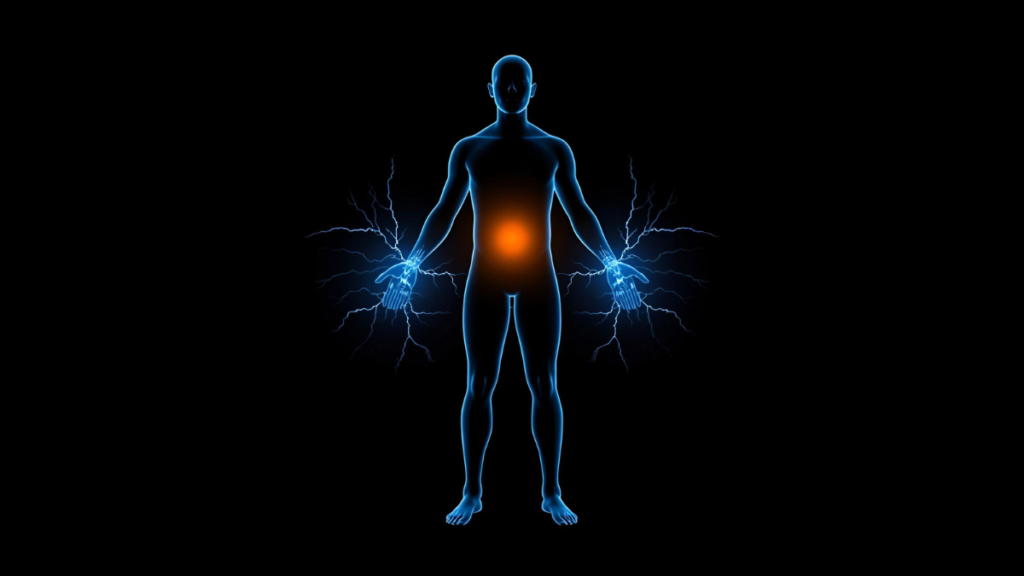
The Enemy: The “Paper Amplifier”
The biggest mistake speakers make is holding a single sheet of A4 or Letter paper.
Paper has no structural integrity. It catches the air and amplifies even the tiniest micro-tremor. A tremor you can’t even feel will make a sheet of paper wave back and forth by two inches.
Immediate Fixes:
- Use Index Cards: They are rigid. They don’t flop.
- Use a Tablet: The weight of an iPad helps dampen the shake.
- Use the Lectern: Put the notes down. Do not hold them.
But what if you have to hold a microphone or a prop? That is where “The Anchor” comes in.
The Solution: “The Anchor” Stance
You cannot stop the adrenaline dump (that is automatic), but you can stabilize the hardware.
When your hands are floating in the air—holding a mic or gesturing loosely—they are essentially unsupported levers. The adrenaline finds the path of least resistance.
To stop the hands shake, you need to create a closed circuit. You need “The Anchor.”
Step 1: The Isometric Press If you aren’t holding anything, press your thumb and index finger together (on the same hand) firmly. Do this at your side. The tension occupies the muscles and burns off a tiny bit of that excess cortisol.
Step 2: Elbow Anchoring If you are holding a microphone, do not let your elbow float in the air (the “Chicken Wing” stance). Tuck your elbow into your ribcage.
- Physics: By pressing your arm against your core, you turn your entire torso into a stabilizer. Your hand can shake, but your core won’t. You are mechanically grounding the vibration.
Step 3: The “Steeple” Reset If you don’t know what to do with your hands, bring them together in a “Steeple” (fingertips touching) or clasp them gently at waist height.
- Why it works: One shaking hand stabilizes the other. It creates a closed loop. It looks confident to the audience, but secretly, you are using your left hand to hold your right hand still.
💡 Pro Tip: Burn the Energy Early
Adrenaline is physical energy. The best way to stop the shaking is to use the fuel before you speak.
Don’t sit still while waiting for the timer to introduce you. Do isometric calf raises under the table. Squeeze your fists and release them. Burn the fuel.
Then, use a visual anchor to focus your mind.
Don’t Fight the Shake
The worst thing you can do is look at your hand, see it shaking, and think, “Oh no, they can see it!”
That thought releases more adrenaline, which makes the hands shake harder. It is a feedback loop from hell.
Break the loop.
- Accept the energy. (Tell yourself: “I’m excited, not scared.”)
- Drop the paper.
- Anchor your elbows.
- Move your feet (walking burns adrenaline).
Your audience doesn’t care if you are nervous. They only care if you have something valuable to say. Stabilize the signal, deliver the message, and let the adrenaline fade naturally.
Ready to test your stability?
The next time you practice, hold your phone in one hand with our timer app running. Challenge yourself to keep the phone steady while you deliver your opening minute.
Try the Unofficial Speech Timer Now
Disclaimer: This guide is a personal resource created by Jel Salamanca. It is not an official publication of, nor is it affiliated with or endorsed by, Toastmasters International.